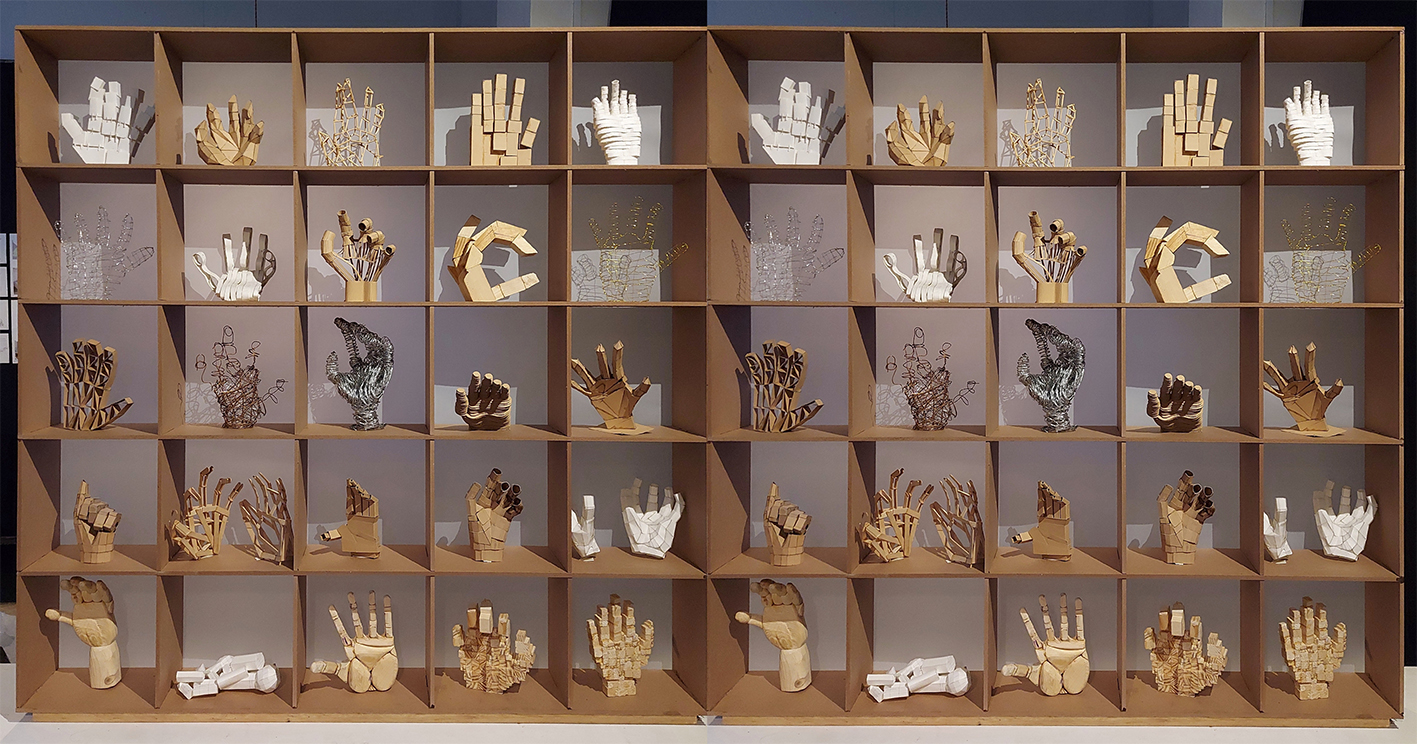

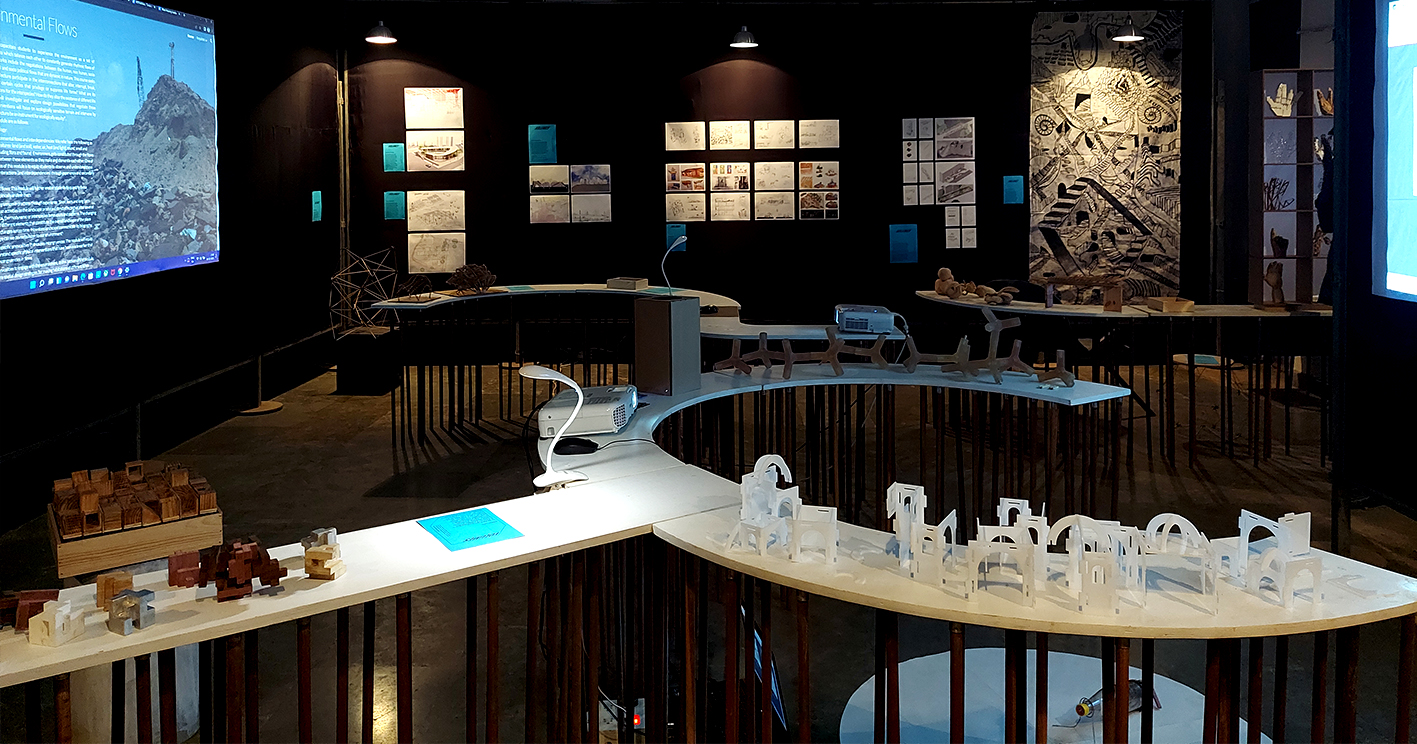


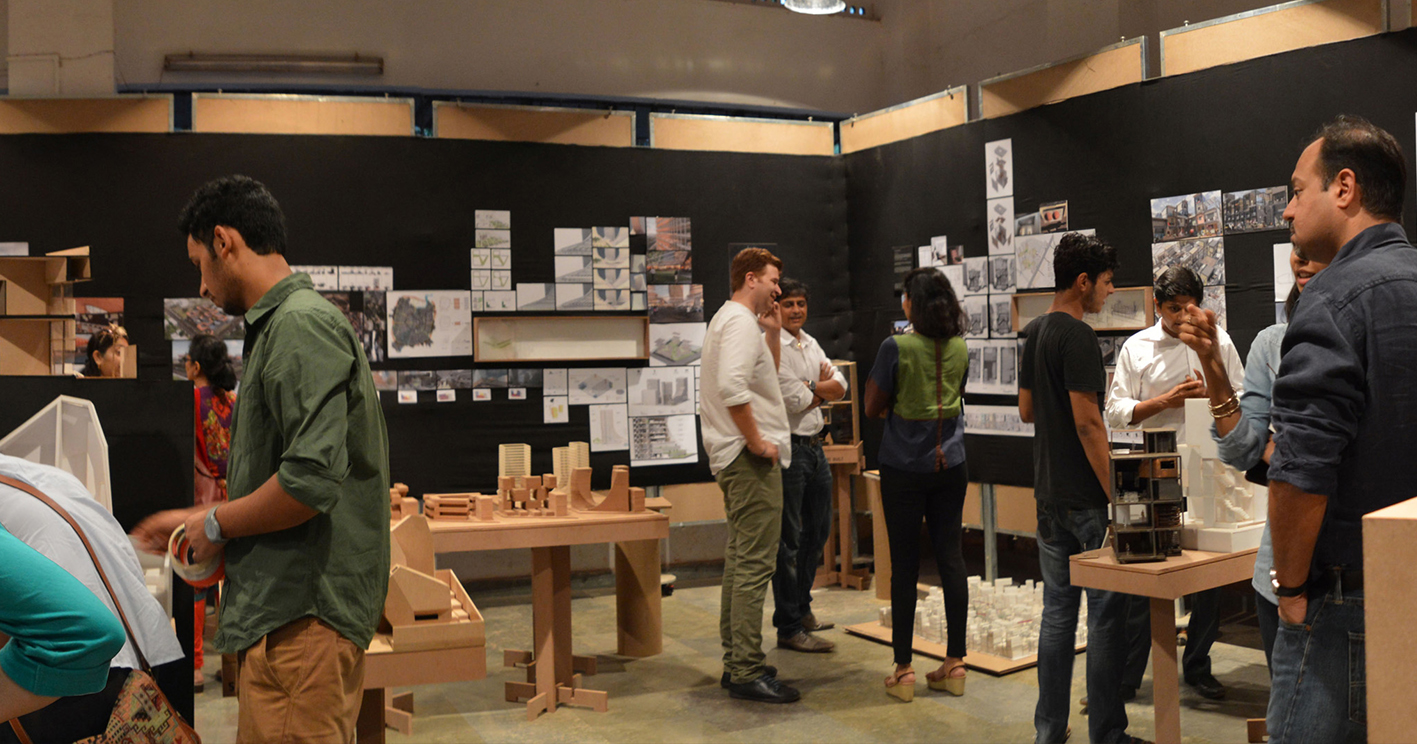
SEA CITY is the School of Environment and Architecture’s outreach programme. SEA City organizes events, lectures, symposia and exhibitions in order to engage with the larger artistic and cultural discursive sphere within and outside the city. SEA City events are completely open to all public, and are attended by a diverse group of people including students, architects, professionals, academics and locals.
next on SEA City
Sharjah Architecture Triennial
in collaboration with School of Environment and Architecture
Sharjah Architecture Triennial
Mumbai Offsite: Architecture Otherwise
in collaboration with School of Environment and Architecture 8, 9, 10 December 2025,
The tremendous growth of urbanized space during the 21st century is dramatically captured in the landscapes of greater Mumbai. Housing crises, environmental degradation and crises of governance are unmistakable. Architects have played a crucial activist and pedagogical role in making the contours of these crises visible, in framing the nature of these problems and offering ideas to government and citizens. These efforts are captured in the forms and activities of new institutions led by architects that move beyond the traditional architectural studio practice. Across South Asia, new institutional forms are evolving alongside hybrid practices involving designers and social thinkers, activists and artists working collaboratively to analyze and propose new forms of spatial practice, geared to the greater collective good.
In this short three day visit co-hosted by School of Environment and Architecture (SEA), Mumbai and the Sharjah Architecture Triennial in the lead up to the Triennial’s third edition, we hope to explore, celebrate and learn from the work of numerous innovative practices and institutions across South Asia. This conversation will be loosely framed around the themes of the third edition, titled Architecture Otherwise: Building Civic Infrastructure for Collective Futures. Our hope is to initiate a dialogue and an exchange between Sharjah and South Asia that will inform and be a part of the third edition’s attempt to revisit architecture as a civic practice rather than a technological one.
Curated by an anthropologist, the edition specifically highlights practices that center people rather than technologies and reframes architecture as a social, ecological, and epistemological practice rather than a purely aesthetic or infrastructural one.
We invite practitioners to share their engagements with the wider cultural landscape of art and aesthetics, architecture and urbanism, economy and environment, and society and politics. The workshop hinges around the question - what have been the key learnings and realisations in the production of space for the participants? How do they envision its evolution in the coming years?
8 December 2025
City Walk with participants
9 December 2025 at SEA, Mumbai
0930 - 1030 : Introductions
SAT’s Longterm Objectives: Mona El Mousfy; Notes from SEA: Neera Adarkar; SAT Curatorial Brief: Vyjyanthi Rao; Mumbai Off-Site with SEA Objectives and Questions: Rupali Gupte and Vyjyanthi Rao
1030 -1200 : Research Otherwise from the Academy
Soumini Raja (AVANI), Rupali Gupte (SEA), Ratoola Kundu (TISS),
Chair: Prasad Khanolkar, Vastavikta Bhagat
1230 -1400 : Community Agencies
Swastik Harish (SHA), Suhailey Farzana, POCAA (Platform of Community Action and Architecture), Co.Creation.Architects, Bhawna Jaimini (Urban Commons), Roshni Nuggehalli (YUVA)
Chair: Rohit Mujumdar, Simpreet Singh
1500 -1700 : Critical Cultural Assertions
Ishita Shah (Curating for Culture), Roshan Mishra (Online), Shahana (Karachi La Jamia) (Online), Rajesh Vora.
Chair: Apurva Talpade, Richa Shah
10 December 2025 at SEA, Mumbai
0930 - 1030 : Urban Engagements
Anirudh Paul (KRVIA/CODE), Deepti Talpade (WRI), Pankaj Joshi (Urban Centre Mumbai)
Chair: Prasad Shetty, Dipti Bhaindarkar
1030 -1130 : Material Experiments in Co-creating Architecture
Pranathi (Abari), Aditya Singh (Hunnarshala)
Chair: Dushyant Asher, Milind Mahale
1130 - 1200 : Closing Comments SAT and SEA
In this short three day visit co-hosted by School of Environment and Architecture (SEA), Mumbai and the Sharjah Architecture Triennial in the lead up to the Triennial’s third edition, we hope to explore, celebrate and learn from the work of numerous innovative practices and institutions across South Asia. This conversation will be loosely framed around the themes of the third edition, titled Architecture Otherwise: Building Civic Infrastructure for Collective Futures. Our hope is to initiate a dialogue and an exchange between Sharjah and South Asia that will inform and be a part of the third edition’s attempt to revisit architecture as a civic practice rather than a technological one.
Curated by an anthropologist, the edition specifically highlights practices that center people rather than technologies and reframes architecture as a social, ecological, and epistemological practice rather than a purely aesthetic or infrastructural one.
We invite practitioners to share their engagements with the wider cultural landscape of art and aesthetics, architecture and urbanism, economy and environment, and society and politics. The workshop hinges around the question - what have been the key learnings and realisations in the production of space for the participants? How do they envision its evolution in the coming years?
8 December 2025
City Walk with participants
9 December 2025 at SEA, Mumbai
0930 - 1030 : Introductions
SAT’s Longterm Objectives: Mona El Mousfy; Notes from SEA: Neera Adarkar; SAT Curatorial Brief: Vyjyanthi Rao; Mumbai Off-Site with SEA Objectives and Questions: Rupali Gupte and Vyjyanthi Rao
1030 -1200 : Research Otherwise from the Academy
Soumini Raja (AVANI), Rupali Gupte (SEA), Ratoola Kundu (TISS),
Chair: Prasad Khanolkar, Vastavikta Bhagat
1230 -1400 : Community Agencies
Swastik Harish (SHA), Suhailey Farzana, POCAA (Platform of Community Action and Architecture), Co.Creation.Architects, Bhawna Jaimini (Urban Commons), Roshni Nuggehalli (YUVA)
Chair: Rohit Mujumdar, Simpreet Singh
1500 -1700 : Critical Cultural Assertions
Ishita Shah (Curating for Culture), Roshan Mishra (Online), Shahana (Karachi La Jamia) (Online), Rajesh Vora.
Chair: Apurva Talpade, Richa Shah
10 December 2025 at SEA, Mumbai
0930 - 1030 : Urban Engagements
Anirudh Paul (KRVIA/CODE), Deepti Talpade (WRI), Pankaj Joshi (Urban Centre Mumbai)
Chair: Prasad Shetty, Dipti Bhaindarkar
1030 -1130 : Material Experiments in Co-creating Architecture
Pranathi (Abari), Aditya Singh (Hunnarshala)
Chair: Dushyant Asher, Milind Mahale
1130 - 1200 : Closing Comments SAT and SEA


next on SEA City
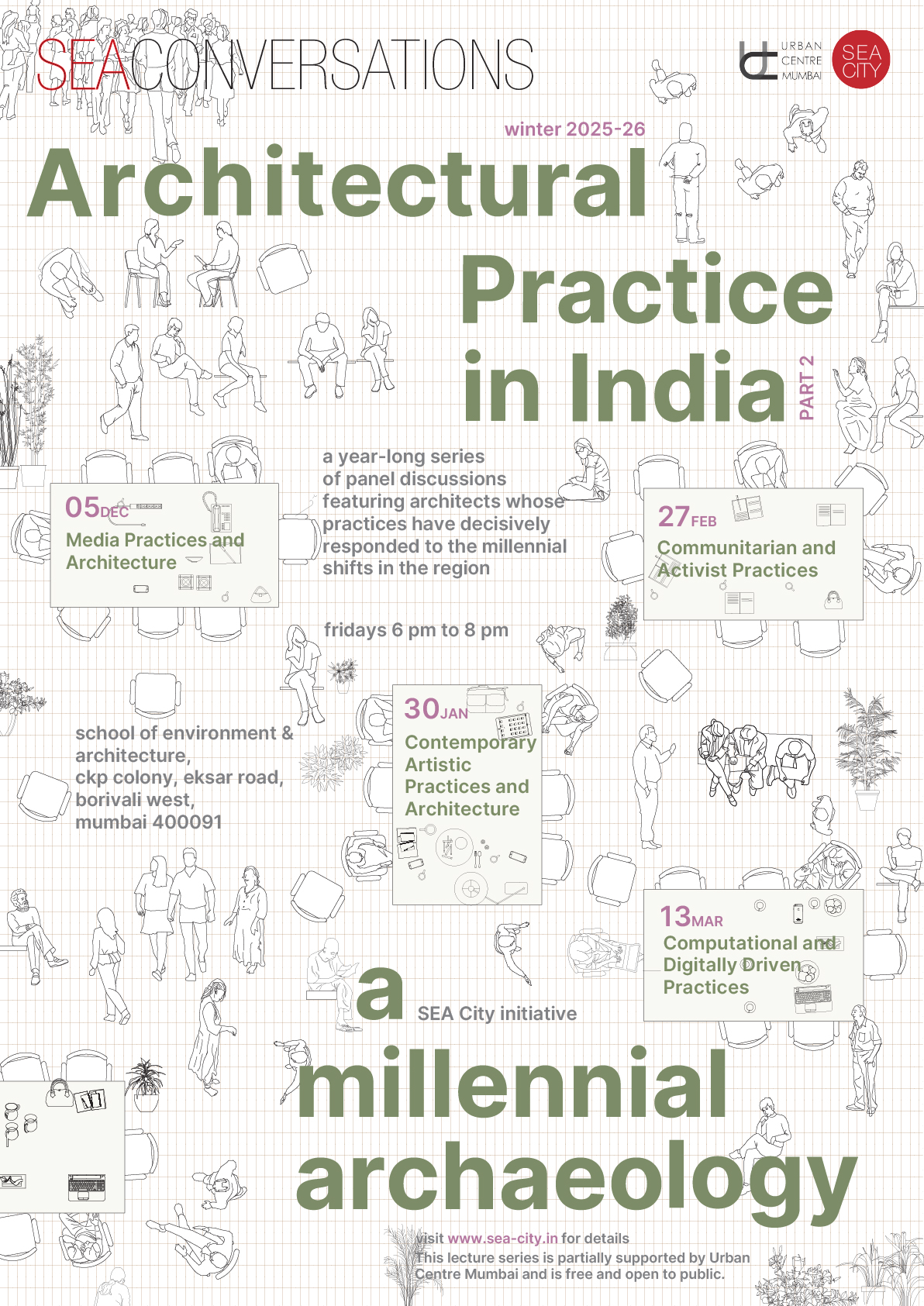
Architectural Practice In India: A Millennial Archaeology - Part 2
winter 2025-26
At the threshold of the first quarter of the millennium, which also marks a generation since India’s economic liberalization, architectural practice in India is ripe for a critical re-evaluation. In this period, the country has gradually, yet starkly shifted from a socialist framework to a neoliberal state, where developmental politics has ramified architectural production into new directions and logics. Existing scholarship on the built environment in India has often focused narrowly on the aesthetics of form, the evolving identity of the architect, or the reception of modernism as inherited from the West. Architectural discourse has largely taken one of two paths: either documenting work deemed academically significant, or framing emerging practices in terms of identity—often measured against binaries such as modern versus indigenous/vernacular. Such approaches tend to posit the architect as a servant of academic canons or fixed ideals.
Architectural practice on the ground, as it appears now, is far more complex - one that exhibits reorientation of spatial ideals and values to reflect a rapidly evolving society increasingly shaped by media, consumerism, and aspirations of globalisation. Once trained architects step into the field, the idealism of modernism is quickly refracted through geopolitical urgencies and the pragmatic demands of practice. What is often overlooked is the inherent political exigency that compels practice to adapt—making the operations and expressions of architecture more malleable and responsive to emerging needs of the market - in its widest extensions. In such contexts, architects evolve new formats, languages, agencies, and strategies to negotiate their professional knowledge to remain relevant within the real-world demands of building reinterpreting spatial briefs through the vocabularies of capital, conservation, environment, real estate, and more.
‘Architectural Practice in India: A Millennial Archaeology’ seeks to examine how architectural practice in India has developed over the last three decades within the framework of the millennial shift in its political economy. What forces—of power, ambition, and institutional pressure—have shaped architectural production during this period and how does it reorganise the delivery of the built environment? What aspects of practice gain currency in the emerging market and how does the professional architect find reconciliations and directions in addressing these. In excavating these variegated forms of practice that shape the unevenness of our built landscape today, these discussions aim to explore tendencies such as the rise of managerial approach, the renewed focus on environmental and heritage concerns, the emergence of artisanal and communitarian agendas, the urgency of urbanistic thinking, response to media and the integration of computational and digital thinking that come to constitute distinct, yet composite strands of spatial practice today.
The new cycle of SEA City Conversations is conceived as a year-long series of panel discussions featuring architects and spatial commentators, whose own practices have decisively responded to the millennial shifts in the region, by means of slipping, fitting or pushing the envelopes of conventional formats of practice. Methodologically, the series will draw upon the professional biographies of practitioners from across the city whose trajectories have remained representatively pivotal in bringing and operating in such changing dynamics of practice. Through reflexive interrogation and collective debate over the upcoming year, the programme imagines to present itself as an open course for the city, and invite the public to participate in a collective architecture history-writing exercise that seeks to critically engage with the evolving realities of contemporary architecture in India.
sessions
Dec 05, 2025 Media Practices and Architecture
Jan 30, 2026 Contemporary Artistic Practices & Architecture
Feb 27, 2026 Communitarian & Activist Practices
Mar 13, 2026 Computational & Digitally Driven Practices
Architectural practice on the ground, as it appears now, is far more complex - one that exhibits reorientation of spatial ideals and values to reflect a rapidly evolving society increasingly shaped by media, consumerism, and aspirations of globalisation. Once trained architects step into the field, the idealism of modernism is quickly refracted through geopolitical urgencies and the pragmatic demands of practice. What is often overlooked is the inherent political exigency that compels practice to adapt—making the operations and expressions of architecture more malleable and responsive to emerging needs of the market - in its widest extensions. In such contexts, architects evolve new formats, languages, agencies, and strategies to negotiate their professional knowledge to remain relevant within the real-world demands of building reinterpreting spatial briefs through the vocabularies of capital, conservation, environment, real estate, and more.
‘Architectural Practice in India: A Millennial Archaeology’ seeks to examine how architectural practice in India has developed over the last three decades within the framework of the millennial shift in its political economy. What forces—of power, ambition, and institutional pressure—have shaped architectural production during this period and how does it reorganise the delivery of the built environment? What aspects of practice gain currency in the emerging market and how does the professional architect find reconciliations and directions in addressing these. In excavating these variegated forms of practice that shape the unevenness of our built landscape today, these discussions aim to explore tendencies such as the rise of managerial approach, the renewed focus on environmental and heritage concerns, the emergence of artisanal and communitarian agendas, the urgency of urbanistic thinking, response to media and the integration of computational and digital thinking that come to constitute distinct, yet composite strands of spatial practice today.
The new cycle of SEA City Conversations is conceived as a year-long series of panel discussions featuring architects and spatial commentators, whose own practices have decisively responded to the millennial shifts in the region, by means of slipping, fitting or pushing the envelopes of conventional formats of practice. Methodologically, the series will draw upon the professional biographies of practitioners from across the city whose trajectories have remained representatively pivotal in bringing and operating in such changing dynamics of practice. Through reflexive interrogation and collective debate over the upcoming year, the programme imagines to present itself as an open course for the city, and invite the public to participate in a collective architecture history-writing exercise that seeks to critically engage with the evolving realities of contemporary architecture in India.
sessions
Dec 05, 2025 Media Practices and Architecture
Jan 30, 2026 Contemporary Artistic Practices & Architecture
Feb 27, 2026 Communitarian & Activist Practices
Mar 13, 2026 Computational & Digitally Driven Practices